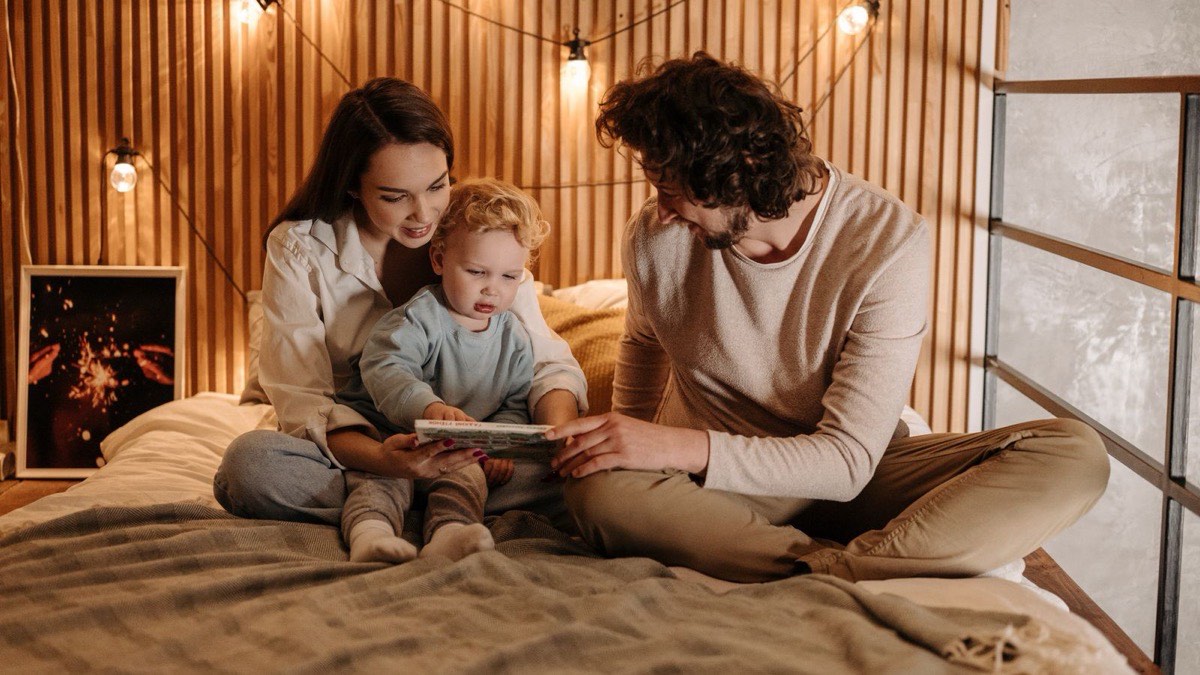
The bedtime routine — and why toddlers fight it
There's a particular defeat in the moment when the story is finished, the lights are off, the kiss has been given — and a small person stands up in the dark and asks for water.
Before any advice, one sentence from the American Academy of Pediatrics that deserves to be read out loud: many parents find their toddler's bedtime the hardest part of the day, and children this age often resist it, especially with older siblings still awake.
That's the AAP naming the problem before offering the fix. It isn't just your house.
What the routine is actually made of
Both the NHS and the AAP describe the same simple thing, in slightly different words.
The NHS list: a bath, night clothes and a fresh diaper, a story, dimmed lights to make the room calm, a goodnight kiss and cuddle, a lullaby. The AAP's version is three words long — brush, book, bed.
That's the whole architecture. Not a system, not a schedule with timers. A short sequence of ordinary things, in the same order, so that the child can feel sleep coming before it arrives. The AAP's recommendation for toddlers is exactly that: a quiet routine so the child understands sleep is on the way, and the same bedtime every night.
What the sources refuse to tell you
This is the part we find genuinely useful, and it's the part most bedtime advice skips.
- There's no official start age. Neither the NHS nor the AAP gives a number for when a bedtime routine should begin. "Start early" is as precise as it gets.
- There's no official clock time. The AAP says the same bedtime every night — it doesn't say 7:00. The right time is the one that fits your family and holds steady.
- There's no official length. Twenty minutes, forty minutes: not specified anywhere we'd cite.
When you find a source that gives you exact numbers for all three, it's worth asking where those numbers came from. Our own read, offered as an observation rather than guidance: short and repeatable beats long and elaborate, because the version you can do on a bad night is the version that survives.
How much sleep is behind the routine
For one- and two-year-olds, the American Academy of Sleep Medicine recommends 11 to 14 hours per 24, including naps, on a regular basis — with the WHO landing on the same band, adding "regular sleep and wake times."
Two cautions travel with that number, and they're the AASM's own. More is not automatically better: regularly sleeping more than the recommended range may also be associated with problems. And individual variation is real — influenced by genetic, behavioral, medical, and environmental factors. The band is where children land, not a score they're marked against.
One thing that carries over from babyhood
The AAP's guidance from about four months onward is to put a baby down drowsy but awake, so they learn to fall asleep on their own, in their own bed. That skill is exactly what a toddler is drawing on at bedtime — and it's why the routine ends before sleep rather than delivering a sleeping child to the mattress.
If bedtime is a battle tonight
Two honest things. First: the AAP has already told you this is the hardest part of the day for many families, so a hard bedtime isn't a report card on your parenting. Second: if you're logging, look at the shape of the week rather than the fight of the night — when naps ended, how the evening ran, what time lights actually went out. Patterns are easier to see across seven days than through one exhausting hour.
And anything that worries you about your child's health or sleep belongs with your child's doctor, who can ask the questions an article can't.
- AAP (HealthyChildren.org) — Bedtime Trouble and Toddlers
- AAP (HealthyChildren.org) — Healthy Sleep Habits: How Many Hours Does Your Child Need?
- AAP (HealthyChildren.org) — Getting Your Baby to Sleep
- NHS — Helping your baby to sleep
- AASM — Recommended Amount of Sleep for Pediatric Populations, consensus statement (2016)