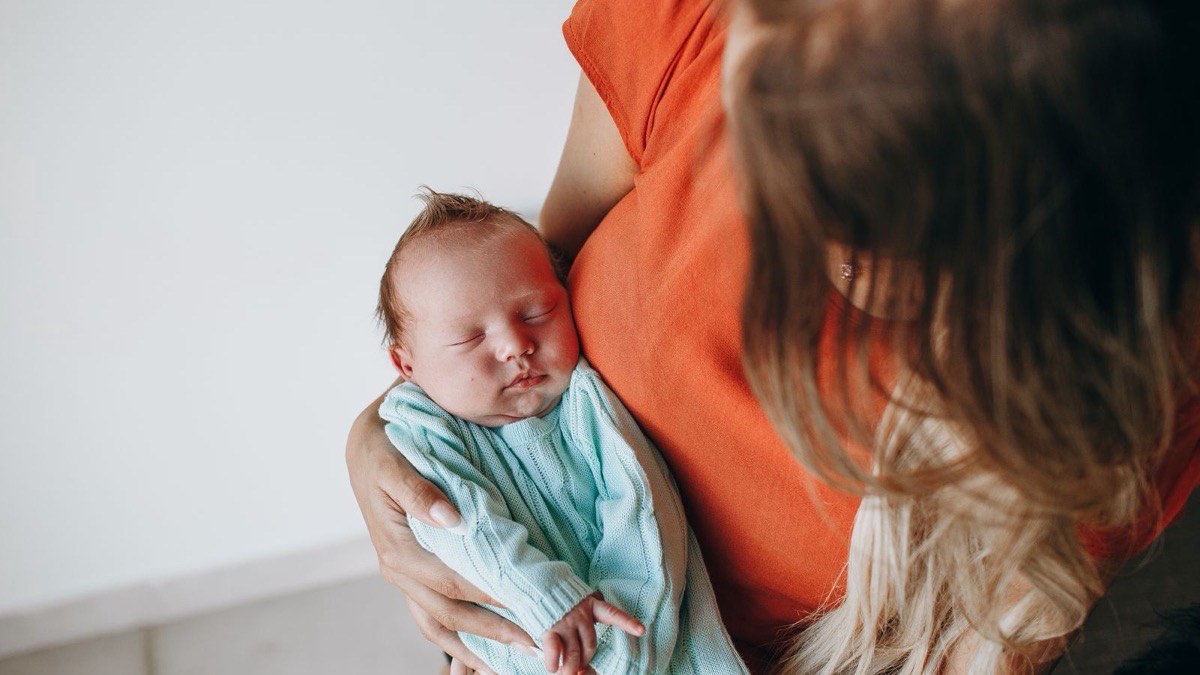
Newborn sleep — the twitching, the grunting, and the days-and-nights mix-up
You're standing over the bassinet at 3am watching your baby twitch, grunt, breathe fast, then go quiet, then breathe fast again — and you cannot tell whether she's asleep, waking, or something you should be worried about. Almost every new parent has stood exactly there. Here is what the sources say you're looking at.
Newborn sleep comes in two kinds
The American Academy of Pediatrics describes newborn sleep as roughly half active sleep and half quiet sleep.
In active sleep — the AAP's name for REM — a baby may twitch or jerk her arms and legs, and her eyes move under closed lids. Breathing is often irregular. In the AAP's words, it may even pause for 5 to 10 seconds and then start again with a burst of rapid breathing — a pattern the AAP calls normal periodic breathing of infancy, which babies generally outgrow by about the middle of the first year.
In quiet sleep, the twitching stops, sleep gets progressively deeper, and she becomes harder to wake.
So here is the reassuring arithmetic: about half of everything your newborn does while asleep looks and sounds like almost-waking. The grunting, the twitching, the noisy uneven breathing — that is the normal texture of active sleep, not a problem to fix. And a baby in light sleep can be startled awake by an everyday noise, which is why the same sound is ignored one hour and wakes her the next.
One line we'll say plainly, because it matters: this describes normal sleep. It is not a way to reassure yourself about a breathing concern you're actually worried about. If something about your baby's breathing feels wrong to you, that is a call to your baby's doctor — today.
Newborns don't have cycles yet
The AAP notes that babies don't have regular sleep cycles until about 4 months of age. Before then, a newborn simply alternates between the two states — cycling through both within a given hour. That's why newborn sleep comes in pieces: the AAP describes about 16 to 17 hours a day, but often only 1 or 2 hours at a time. (The NHS says it more loosely: total sleep varies, but "can be around 18 hours.") Long, consolidated stretches are a later chapter. Right now, short and frequent is the design.
Days and nights — a mix-up your baby learns her way out of
Newborns don't arrive knowing that night is for sleeping. The NHS is refreshingly direct that this is taught, and taught from the start:
- Days: open the curtains, play, and don't worry too much about everyday noise while she naps.
- Nights: keep the lights low, don't talk much, keep your voice quiet, and put her down as soon as she's been fed and changed.
The AAP says the same thing from the other direction: make daytime playtime, and keep babies awake longer during the day — it helps them sleep for longer periods at night.
And it fades on its own. The AAP describes how, as the nervous system develops through the first month, a baby begins to settle into a pattern of crying, sleeping, eating and playing that matches the family's own day — by the end of the month, awake for longer stretches during the day and more alert at those times. In the NHS's words: your baby will gradually learn that night-time is for sleeping.
The evening crying that comes with it
Two things routinely arrive together in the first weeks: broken sleep and a stretch of evening fussing. The AAP describes the shape of it clearly. Newborns routinely cry 1 to 4 hours a day. Regular fussing usually peaks at about 3 hours a day by 6 weeks, then declines to 1 or 2 hours by 3 to 4 months. And it tends to cluster — the AAP says typically between 6pm and midnight, "just when you, too, are feeling tired from the day."
Knowing the curve doesn't make the evening shorter. But it does tell you two useful things: it peaks and then it eases, and it's not caused by something you're doing wrong.
On responding — the AAP is unambiguous, and it's worth taking to heart at 3am: you cannot spoil a young baby with attention, and if you answer their calls for help, they'll cry less overall.
Three things the AAP asks every parent to carry
- A baby should never be shaken. No matter how impatient or angry you become.
- It's okay to step away. Lay the baby on her back in the crib or another safe place and leave the room for a few minutes.
- Tell your own doctor if you're feeling depressed or having trouble dealing with your emotions. The first weeks are hard on the person doing them, and that person's health counts too.
- AAP (HealthyChildren.org) — Stages of Newborn Sleep
- AAP (HealthyChildren.org) — States of Consciousness in Newborns
- AAP (HealthyChildren.org) — Getting Your Baby to Sleep
- AAP (HealthyChildren.org) — Responding To Your Baby's Cries
- AAP (HealthyChildren.org) — Colic Relief Tips for Parents
- NHS — Helping your baby to sleep